What is an AI Agent?

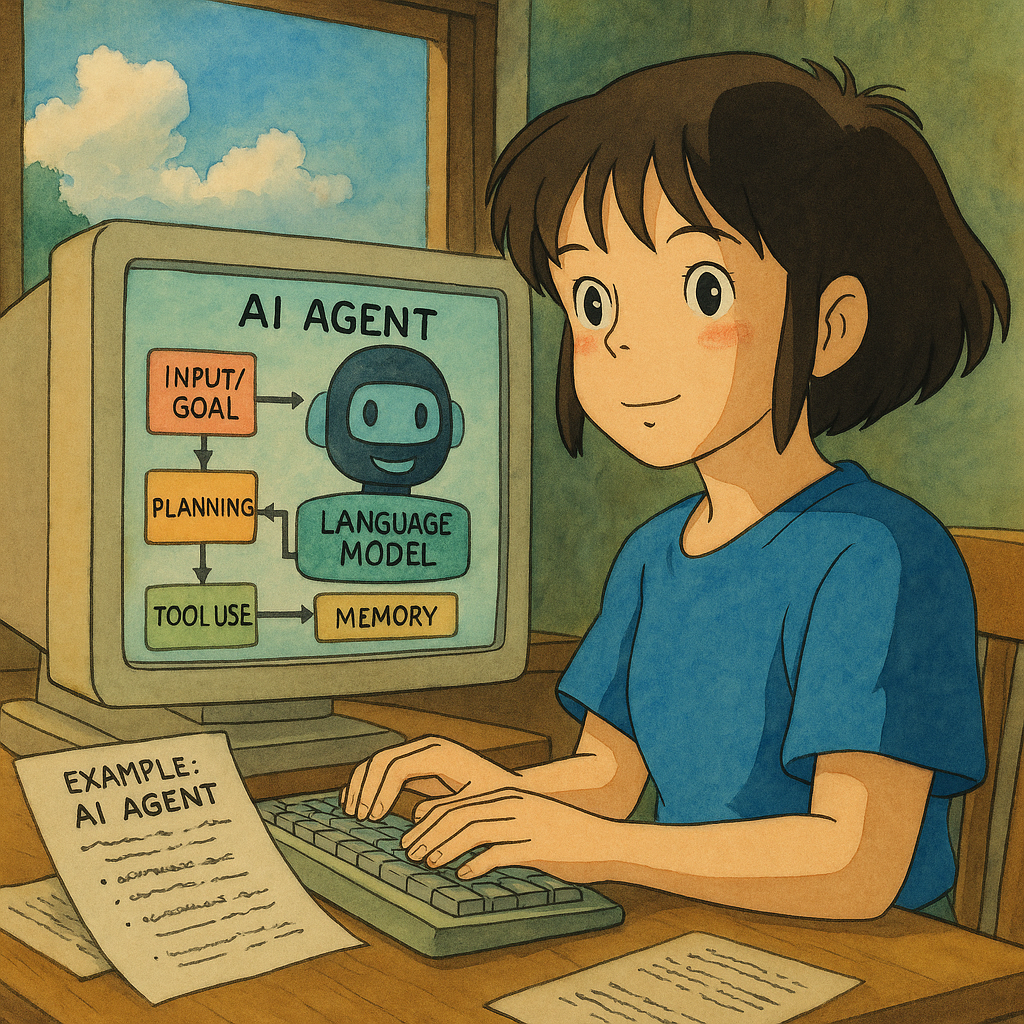
An AI Agent is a software system that can perceive, reason, decide, and act on its own to achieve a goal — often using language models like ChatGPT, Gemini, or Claude.
🔧 If You're from a Traditional Programming Background:
Traditional programming:
- You write step-by-step instructions.
- The system follows exactly what you code — nothing more, nothing less.
Example:
if temperature > 100:
    turn_on_cooling()
else:
    turn_off_cooling()
AI Agent:
- You give it a goal, like:
"Keep the room comfortable based on user's preference." - It figures out what actions to take, when, and even how — maybe by reading sensor docs, querying APIs, or talking to users.
⚙️ How an AI Agent Works:
- Input/Goal – It gets a goal or task (e.g., "Plan a 7-day Italy trip").
- Planning – It breaks the goal into steps (book flights, hotels, activities).
- Tool Use – It uses APIs, websites, or software tools to gather info or take action.
- Language Model Brain – It thinks using models like ChatGPT, Gemini, Claude to understand language, plan, and reason.
- Memory – It remembers context or past actions.
- Execution – It performs tasks autonomously or semi-autonomously.
💡 Example: AI Agent vs Traditional App
Let’s say you want to automate invoice processing.
| Feature | Traditional App | AI Agent |
|---|---|---|
| Input | You write code to parse PDF, extract data, match it with DB | Just say “Process all incoming invoices and send reminders” |
| Intelligence | Only does what’s coded | Learns from invoices, adapts to formats |
| Behavior | Static logic | Dynamic decision-making |
| Interaction | Button click or fixed script | Can chat with vendor to clarify missing details |
| Output | Predefined fields | Can also detect anomalies, suggest actions |
🚀 Why AI Agents Save Time, Money, and More
| Parameter | Benefit |
|---|---|
| ⏱ Time | Automate complex tasks like research, customer support, document processing |
| 💰 Money | Reduce manpower costs by automating repetitive work |
| 🧠 Intelligence | Make decisions without constant programming |
| 🔄 Adaptability | Learns and adapts over time (e.g., customer habits) |
| 🌐 Tool Integration | Can use tools like email, calendar, APIs, databases |
| 💬 Language Capable | Understands and works with natural language, like a human assistant |
🔍 Where AI Agents Are Used Today:
- Customer support agents that solve tickets without humans.
- Travel planners that book everything automatically.
- Research agents that read PDFs and summarize them.
- Dev assistants that write code, debug, or manage cloud deployments.
🧠 Powered by Language Models
AI agents use LLMs (Large Language Models) like:
- ChatGPT (by OpenAI)
- Gemini (by Google)
- Claude (by Anthropic)
These models act like the "brains" that:
- Understand natural language
- Break down tasks
- Generate outputs
- Talk with APIs or humans
🔄 Summary: Key Differences
| Feature | Traditional Programming | AI Agent |
|---|---|---|
| Control | You define every logic step | You define the goal, it figures out steps |
| Flexibility | Low | High |
| Learning | None | Yes (from data, context, or feedback) |
| Time to Build | Weeks or months | Hours or days |
| Effort | High for changes | Low — can generalize or auto-adapt |